
How to use a whipper snipper: stance, edges, long grass and line
By Clyde Macababbad, founder of Mowie · · 6 min read · read 13 times
Checked against 11 sources on
To use a whipper snipper, hold the head flat and just above the grass, swing it right to left, and let only the last 20 mm of line do the cutting. STIHL teaches the stroke as a semicircle from right to left, moving gradually forward, so the clippings land on ground you have already done. Everything after that is which job you are on.
| Job | How to hold it | Line |
|---|---|---|
| Edge along a path | Head rolled 90 degrees, line spinning vertically in the seam | Round, 2-2.4 mm |
| Fence line | Flat, line a finger's width off the plinth, one direction | Round or square, 2.4 mm |
| Around a tree | Slow outline pass at part throttle, never touching bark | Round, 2-2.4 mm |
| Long grass | Two passes: top half swinging right, bottom half swinging left | Square, 2.4-2.7 mm |
| Open ground | Quadrants, outer sides towards the middle | Square, 2.4-2.7 mm |
A whipper snipper decides whether a mow looks finished. The mower handles the middle. Line handles the path edge, the base of the fence and the ring around the letterbox, and that last five minutes is the part people photograph. Beginners hold the head flat when they should have it turned, scalp a bald stripe beside the driveway, then spend twenty minutes wrestling line back into the spool.
Five skills sort it out. Stance and strap, edging, fence lines and trees, long grass, reloading. I have a kikuyu lawn in Mill Park and I watch mowers do all five every week on jobs booked through the site, so this is written for two people at once: someone with a $179 battery unit and a Saturday, and someone starting out with a STIHL FS 38 or FS 55 who has to do forty of these a week without wrecking a fence.
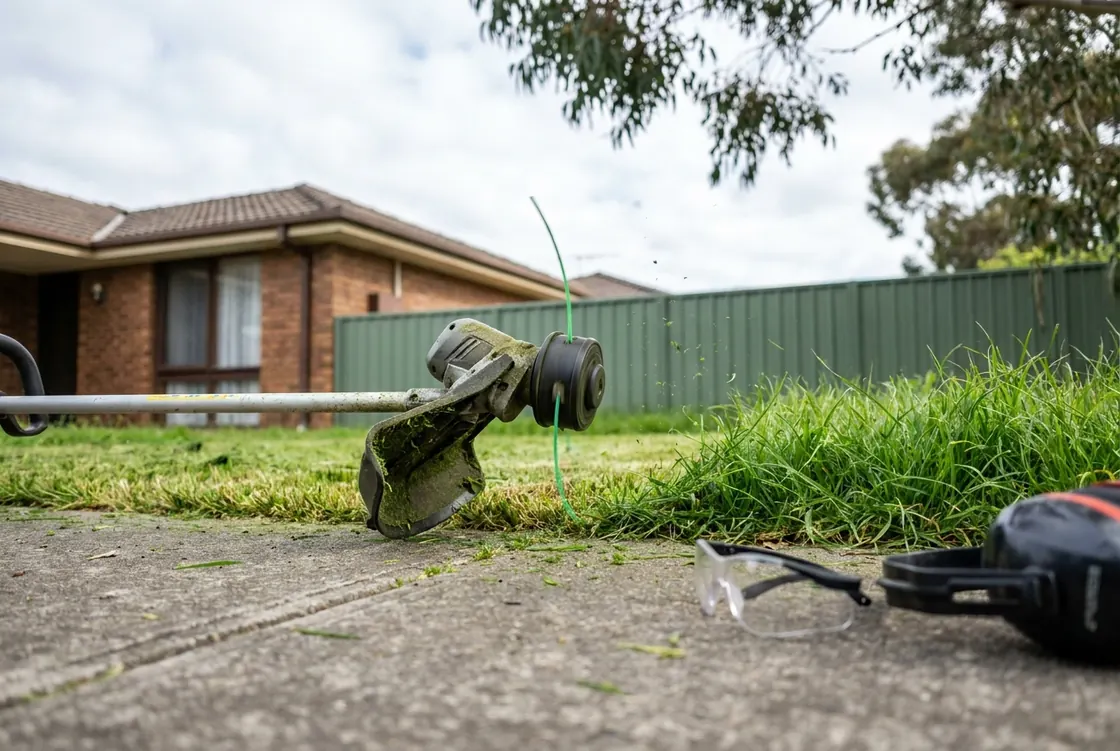
Your first go: strap, stance and which way it throws
Clip the strap on, even if the machine is light. Ryobi's 18V ONE+ kit weighs 2.4 kg and quotes up to 42 minutes on the 4 Ah battery. Your forearm gives out well before the battery does. Set the shaft so the head rests flat on the grass while you stand upright with your elbows near your ribs, and if you find yourself stooping, the shaft is too short.
Every trimmer I have used spins anticlockwise, which puts the cutting side on the left of the head and throws grit out the same way. So work right to left. STIHL's own technique page describes a semicircle from right to left, moving gradually forward, with the cuttings falling onto the surface you have already mown. Do it backwards and you spend an hour walking through your own debris.
Only the tip cuts. Push the whole head into a clump and the motor labours, the line wears back to the eyelet, and you are reloading before the back fence. Skim it. Take a little, move on, come back for a second pass if the first looks thin.
How to do edges with a whipper snipper
Edging is the same tool rolled 90 degrees, so the line spins vertically and cuts down into the seam where lawn meets concrete. Plenty of battery units build that in. Ryobi lists a 180 degree rotating shaft on the R18LTR24 for keeping edges crisp, and CHOICE's buying guide tells you to look for a rotating head before you buy. A curved-shaft petrol unit like the FS 38 does not rotate. You roll your wrists and hold the angle yourself, which is a skill rather than a feature, and it is why a straight shaft is worth the extra money if you do this for a living.
Walk the path slowly with the line touching the concrete, not chewing at it. Cut a shallow groove on the first lap and deepen it on the second if you want the sharp line. Five to ten millimetres every week or two keeps the edge where you put it. Leave the same edge until October and you are cutting three months of kikuyu runners with a nylon string, which is slow and expensive in line.
Couch and kikuyu both take a hard edge and fill back in quickly. Buffalo is slower to recover, so keep the cut shallow on a buffalo lawn and accept a softer line than the one you would get on couch.
Fence lines, tree trunks and the bits the mower cannot reach
Along a colourbond fence, hold the head flat and keep the line a finger's width off the plinth. That bottom rail will shred line all afternoon if you lean on it. Work the run in one direction instead of sawing back and forth, and the grass ends up at one even height rather than a wave.
Trees are where real damage happens. Nylon line takes bark off a young trunk as easily as it takes the top off grass, and a tree ringbarked at the base does not come back. STIHL's guidance is to mow an outline around trees and bushes first, then do the rest of the area. Better again: lay a mulch ring about 300 mm wide around the trunk and keep the trimmer out of it entirely. The damage from a careless pass shows up the following summer when the canopy thins, long after anyone connects it to the trimmer.
Fence lines are a paid extra on Mowie rather than part of a standard mow, and the price guide adds about $15 for them. Path and driveway edges are already in the mow price, which is why a bid with no edging in it should read as a warning rather than a bargain.
How to use a whipper snipper on long grass
Knee-high grass will not come down in one pass. STIHL's instruction for very long growth is two directions: cut the top part by moving the tool to the right, then cut the bottom part moving it back to the left. Top half, bottom half. Clear what you drop before the second pass, because cut material lying over standing material hides the ground and the ground is where the bricks are.
Lawn Solutions Australia puts the limit at one third of the leaf height per cut. A lawn left since June wants two or three visits a week apart, not one brutal scalping in September. If the block is properly gone, a trimmer is the wrong first tool anyway and a brushcutter blade or a hired slasher is the right one. The whole recovery sequence is its own article.
On open ground, STIHL suggests quadrants, working the outer sides towards the middle, and on a slope cutting a strip straight across then walking back along the track you made. Worth knowing if you are clearing a nature strip on Plenty Road rather than trimming around a Hills hoist.
Putting the cord on, and what thickness to buy
There are two feed systems. A bump feed pays out more line when you tap the head on the ground at full revs; an automatic head does it for you, like the Ryobi, which feeds line when the trigger is released. CHOICE lists both, along with line-length-limiting blades in the guard that trim new line back so the motor is not dragging 300 mm of nylon around.
Reloading works much the same on most heads. Pop the spool cap, wind the line on in the direction of the arrow stamped into the plastic, keep both ends the same length, and stop before the spool is full. An overfilled spool tangles and welds to itself on a hot day, and then you are pulling the head apart in someone's front yard. Ten minutes with the manual on the first reload saves an hour on the twentieth.
Thickness follows the job. These are STIHL Australia's own line prices on 21 September 2026, and their own descriptions of what each is sold for.
| Line | Sold for | Price | Use it on |
|---|---|---|---|
| Round 2.4 mm | "Quiet, round mowing lines" | $10 a roll | Weekly edges, around trees, anything domestic |
| Square 2.4 mm | "Clearing work and tough weeds" | From $61 a roll | Fence lines, thick kikuyu, first cuts |
| Square 2.7 mm | "Clearing work and tough weeds" | From $61 a roll | Straight-shaft petrol units doing overgrown blocks |
| Round 3.3 mm | "Trimming edges and cutting grass" | From $19 a roll | Brushcutter-class machines only |
Do not put heavy line in a small head. The 18V Ryobi runs 2 mm, and forcing 2.7 mm through a head rated for 2 mm loads the motor and chews the eyelets. Check the manual once and buy the right roll forever.
Safety gear, and the hours you can run it in Victoria
Glasses first, and not the sunglasses you drove over in. CHOICE says plainly that you still require eye protection even with the guard fitted. STIHL's safety page asks for safety glasses, face protection and safety boots, plus gloves, and says to keep people and animals out of a 15 metre radius because of flying stones. Fifteen metres is most suburban front yards. The practical version is to get the kids and the dog inside before you pull the cord.
Ears next. Ryobi rates that 18V trimmer at 94.2 dB(A) and a petrol two-stroke is louder again. WorkSafe Victoria treats having to raise your voice to be heard a metre away as the sign that noise needs assessing. You cannot hold a conversation next to a running trimmer, so earmuffs go on. They are the cheapest thing in the kit.
Windows and cars take whatever the line throws. STIHL asks for a safety distance from vehicles and windows and a look over the ground for branches and roots beforehand. Two minutes picking up stones beats a replacement windscreen and an awkward conversation with a neighbour.
Then the hours. EPA Victoria prohibits a garden tool that can be heard in a neighbour's habitable room before 7am and after 8pm on weekdays, and before 9am and after 8pm on weekends and public holidays. That is state law, not a council by-law, so it reads the same in Whittlesea as it does in Bayside. Melbourne mowers lose a lot of Saturday mornings to the 9am start in spring.
What goes wrong, and how to stop it
- Line breaking every thirty seconds. The head is buried in the work, or the line is resting on brick and concrete. Cut with the last 20 mm and ease the revs back in tight spots.
- A bald stripe beside the path. The head was tipped nose-down. Hold it level, skim, and take the second pass instead of forcing the first.
- A stone through the front window. Rake the strip before you start and keep the head pointed along the house, not at it.
- The motor labouring in thick grass. Full throttle, smaller bites, two passes. Petrol units bog at low revs and battery units drain fast when the head is loaded.
- Flat battery at the back fence. Ryobi's 42 minutes is a no-load figure and real grass eats into it. A second battery costs less than a second trip.
- The petrol unit will not start. Fuel older than a month, a choke left closed after four pulls, or a plug wet from flooding. Fresh two-stroke mix and a dry plug fix most of it.
- Cuttings all over the driveway. Working left to right throws everything onto the concrete. Turn around and swing the other way.
When it is worth paying someone instead
Ryobi's battery trimmers run from $99 tool-only to $399 for the 36V brushless kit, and the STIHL FS 38 is $279 including GST. CHOICE puts the typical line trimmer around $200 to $300, with the models it tested spanning $59 to $1,047. Add line, add earmuffs, add the Saturday.
A mow on Mowie for a typical 165 m² Melbourne block runs $95 to $135, and the edges are already inside that number, with fence lines about $15 on top. Buy the trimmer if you enjoy the work, because a sharp edge on your own lawn is a good hour. Otherwise list the lawn and let the mowers working your suburb bid on it with gear they already own.
Quick answers
What line thickness should I use in a whipper snipper?
Match what your head is rated for before anything else. Most 18V home units run 2 mm line, and STIHL sells round line from 2.4 mm, described as line for trimming edges and cutting grass, and square line from 2.4 mm to 3.3 mm for clearing work and tough weeds. Thicker line in a small motor slows the head and wears the eyelets out.
Why does my whipper snipper line keep breaking?
Nearly always because the whole head is buried in the work instead of the last 20 mm of line doing the cutting, or because you are leaning the line on concrete, brick or the bottom rail of a fence. Ease back and drop the revs in tight spots. Line that has sat in a hot shed for a year also snaps on contact.
Can you cut a whole lawn with a whipper snipper?
You can, and the lawn will show it. A trimmer cuts at whatever height your arms happen to hold, so the finish comes out wavy and the edges of each pass scalp. Use it on a steep bank or a nature strip, then use it after the mower on everything else.
What time can I use a whipper snipper in Melbourne?
From 7am to 8pm Monday to Friday, and from 9am to 8pm on weekends and public holidays. EPA Victoria sets those hours for any powered garden tool that can be heard inside a neighbour's home, and they apply across the state rather than council by council.
Find your suburb, what a cut costs there and which mowers cover it.
Where this comes from
Each source below backs a specific claim on this page. Last read on . We take no payment from anyone linked here.
- 1. STIHL Australia: how to mow correctly with a brushcutter - swing the tool in a semicircle from right to left moving gradually forward; very long grass or tough weeds are cut in two directions, top first moving right and the bottom moving left; the quadrant method works the outer sides towards the middle; mow an outline around trees and bushes first
- 2. STIHL Australia: grass trimmer safety - always wear safety glasses, face protection and safety boots; keep people and animals out of a 15 metre radius because of flying stones; check the working area for obstacles and keep a safety distance from vehicles and windows
- 3. STIHL Australia: FS 38 petrol grass trimmer - $279.00 including GST, 4.1 kg without cutting tool, 27.2 cm3 engine, AutoCut C 6-2 mowing head, listed 21 September 2026
- 4. STIHL Australia: grass trimmer line - round mowing line is listed for trimming edges and cutting grass (3.3 mm from $19; the quiet 2.4 mm round is $10), square line for clearing work and tough weeds (2.4 mm to 3.3 mm, from $61), listed 21 September 2026
- 5. RYOBI Australia: 18V ONE+ 25cm/30cm line trimmer 4Ah kit - $179 (was $199), 2.4 kg, 2 mm line that auto-feeds when the trigger is released, 180 degree rotating shaft for edging, up to 42 minutes no-load runtime, 94.2 dB(A), listed 21 September 2026
- 6. RYOBI Australia: line trimmers and brushcutters - the battery line trimmer range runs from $99 tool-only to $399 for the 36V brushless kit, listed 21 September 2026
- 7. CHOICE: how to buy the best line trimmer - line trimmers typically cost around $200 to $300 and the models CHOICE tested ran from $59 to $1047; look for a head that rotates for vertical edging, bump-feed or automatic line, and line-length-limiting blades; eye protection is still required with the guard fitted
- 8. EPA Victoria: residential noise - a lawn mower or grass-cutting tool heard in a neighbour's habitable room is prohibited before 7am and after 8pm on weekdays, and before 9am and after 8pm on weekends and public holidays
- 9. WorkSafe Victoria: noise - having to raise your voice to be heard a metre away is the sign that noise needs assessing and hearing protection provided
- 10. Lawn Solutions Australia: why mowing height matters - grass should be brought down by no more than one third of the leaf height at any one mowing
- 11. Mowie price guide - whipper-snipping fence lines is an extra worth about $15, and a typical 165 m2 mow with the edges included is $95-135
Clyde started Mowie in Mill Park in 2026 and runs it day to day. The prices and timings in these guides come from the jobs booked through the site and from the mowers who do them, and everything else is checked against the source listed beside it. He lives on a kikuyu lawn in Melbourne's north that has taught him most of this the hard way.
More about Mowie and Clyde · Tell us if something here is wrong