
NDIS lawn mowing: what is covered, the 2026-27 hourly rate, the code and how to claim
By Clyde Macababbad, founder of Mowie · · 10 min read · read 49 times
Checked against 24 sources on
Yes, the NDIS pays for lawn mowing when your disability stops you doing it yourself. It is funded by the hour as House or Yard Maintenance, item number 01_019_0120_1_1, at up to $59.01 an hour in 2026-27. The limit applies when a plan manager or the NDIA pays the bill, and since 24 September 2026 it is law. If you self-manage you can agree any price. The mower needs an ABN, and has to be a registered NDIS provider only when the NDIA manages your funding itself. A typical Melbourne lawn takes 40 to 60 minutes, so a visit comes to somewhere between $39 and $89 on a managed plan, depending on the time it takes and the travel you agree.
| How the plan is managed | Who pays the mower | Price limit | Registered mower needed? |
|---|---|---|---|
| Self-managed | You pay, then claim it back in the my NDIS app | None | No |
| Plan-managed | Your plan manager pays the mower's invoice | $59.01 an hour | No |
| NDIA-managed | The NDIA pays through its provider portal | $59.01 an hour | Yes |
Jump to: what is covered, the rate, the code and the paperwork, choosing a mower, how it works on Mowie.
I run a lawn mowing marketplace. I'm not a disability service and this isn't advice about your plan. It is what the NDIS's own documents say about paying for a mow, and every figure links to the page it came from. If you mow lawns and want this work, your side of it is in NDIS lawn mowing jobs.
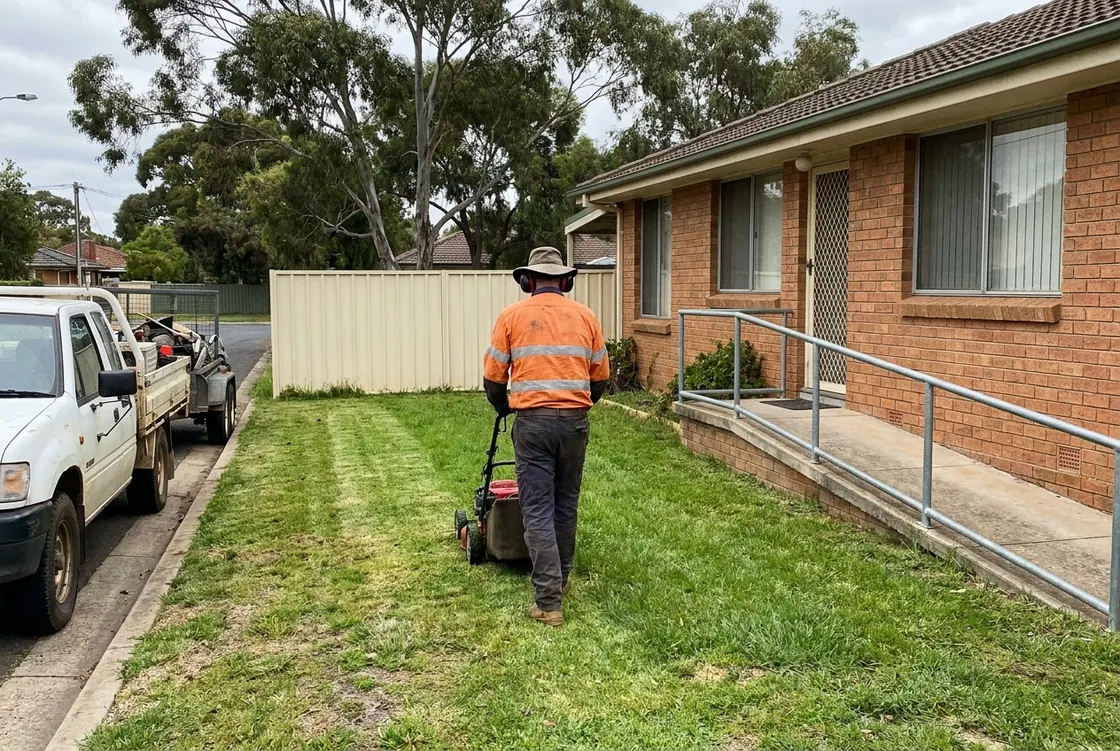
Does the NDIS cover lawn mowing?
Yes, as a household task, when you can't do it yourself because of your disability. What counts as an NDIS support is set by rules made in October 2024. Item 23 in those rules is household tasks: "supports that provide assistance with essential household tasks that a participant is not able to do themselves because of their disability". One of the kinds it names is "house or yard maintenance". The NDIA's claiming rules describe the item the same way: "performing essential house and/or yard activities that the participant is not able to undertake".
Two phrases in the first quote matter. "Essential" is about keeping a yard safe and usable. The NDIA doesn't publish a list of jobs, but one plan manager's guide names lawn mowing, trimming edges and hedges, weeding and clearing walkways among the ones the NDIS may pay for, and says it won't pay for repairs, renovations or improvements. "Because of their disability" is why the same lawn can be funded for one person and not for their neighbour.
The gear is never covered. The same rules put "standard household (including garden) items, appliances, tools and products" on the list of things that are not NDIS supports. A plan pays for the person doing the mowing. It doesn't buy a lawn mower, a whipper snipper, fertiliser or mulch.
The money comes out of the Core budget, under Assistance with Daily Life, which is the 01 at the front of the item number. Whether your own plan has money for the yard is a question for your plan manager, support coordinator or NDIS contact. I can only tell you what the rules allow.
What is the NDIS lawn mowing rate in 2026-27?
$59.01 an hour is the most a plan manager or the NDIA can pay for lawn mowing anywhere in Melbourne. It is a maximum, and a mower can charge less. The NDIS Pricing Schedule 2026-27 lists House or Yard Maintenance at $59.01 an hour, up 3.6% on last year, with higher limits in remote areas. On 5 October 2026 two of the big plan managers' help pages still showed last year's $56.98.
| House or Yard Maintenance, per hour | National | Remote | Very remote |
|---|---|---|---|
| 2025-26 | $56.98 | $79.77 | $85.47 |
| 2026-27 | $59.01 | $82.61 | $88.52 |
Until this year the limits were the NDIA's own pricing arrangements. In September the Minister signed a pricing determination, and from 24 September 2026 the maximum for any support is the amount in the pricing schedule. The NDIA's pricing page says "NDIS providers can't charge more than the maximum price limits". It makes no difference whether the mower is registered, because the NDIA's claiming rules tell plan managers to hold prices to the limit "regardless of whether the participant purchases the support from a registered or an unregistered provider".
The limit doesn't apply if you self-manage. The pricing page says the maximum prices "only apply to NDIA-managed and plan-managed participants", so a fixed price for the job is fine. Where GST applies, "the price limit is inclusive of GST", so no GST is added to the $59.01.
The NDIA says it "will shortly publish updated pricing and claiming guidance documents". Until it does, the travel and cancellation rules below come from the 2025-26 Pricing Arrangements and Price Limits, the latest version on its site.
How many hours is a mow?
Forty to sixty minutes on site for a typical Melbourne lawn, which is $39 to $59 before any travel. The NDIS pays for time, so the invoice is for the minutes worked, whatever the size of the lawn. Our own figures put a typical 165 m² suburban lawn at 40 to 60 minutes for the mow, the edges and the blow-down, a courtyard at 20 to 30 minutes, and a 350 m² corner block near an hour and a half.
Travel can be billed as well, if you agreed to it before the visit. The claiming rules allow "up to 30 minutes of travel" to a participant in Melbourne, charged at the same hourly rate as the mowing, and a mower with several participants on one run can split it between them. A contribution to running the vehicle, up to $0.99 a kilometre, can be agreed too.
| Lawn | Time on site | Mowing only, at $59.01 an hour | With the full 30 minutes of agreed travel |
|---|---|---|---|
| Courtyard, about 60 m² | 20 to 30 min | $20 to $30 | $49 to $59 |
| Typical block, 165 m² | 40 to 60 min | $39 to $59 | $69 to $89 |
| Corner block, 350 m² | About 1.5 hours | $89 | $118 |
Those figures are rounded to the dollar. Compare them with what mowers quote by the job. A one-off standard visit on a 165 m² lawn draws bids of about $95 to $135 in our Melbourne price guide, so even with the travel the capped figure is less than most mowers quote. Expect some mowers to say no to plan-managed work for that reason.
For a plan meeting, work the cost out for the year. Kikuyu and couch grow fastest through the warm months. Fortnightly then and monthly through winter is about twenty visits, and at $89 a visit that is $1,780.
What is the NDIS code for lawn mowing?
01_019_0120_1_1, House or Yard Maintenance. Lawn mowing, gardening and yard maintenance all go on this one item number, billed by the hour. The 01 is the Core category, Assistance with Daily Life, and the 0120 is Household Tasks. Nothing in the schedule is called lawn mowing or lawn maintenance. Gardening goes on the same number.
| Item number | Name | 2026-27 limit |
|---|---|---|
| 01_019_0120_1_1 | House or Yard Maintenance | $59.01 an hour |
| 01_799_0120_1_1 | Provider travel, non-labour costs | No set limit. Up to $0.99 a kilometre is treated as reasonable |
An invoice that leaves the code off, or shows one price for the whole job, is likely to come back unpaid. Plan Partners, a plan manager, tells gardeners the NDIS "will not accept just a price for the job on your invoice without breaking it up into hours", and that extras such as lawn fertiliser have to be built into the hourly rate. Another plan manager, My Plan Manager, lists what a provider's invoice needs:
- an invoice number
- the provider's ABN and contact details
- the participant's name and NDIS number
- the date of each visit
- a description of each service with the item number and the hours delivered
- the hourly rate charged
Travel time is shown on its own line under the same item number.
How do you pay and claim on each kind of plan?
If you self-manage, you pay the mower and claim it back. If you have a plan manager, the mower invoices them. If the NDIA manages your funding, a registered provider claims through the NDIA's portal. Your plan says which applies to you, and some plans use more than one.
If you self-manage, you can claim first or pay first. The NDIA's page on paying for supports says you can claim on the mower's invoice and pay them once the money lands, or pay with your own money and claim with the receipt, in which case the money will "usually be sent to your bank account within 2 business days". The claim in the my NDIS app asks for the dates, the support category, the amount, the provider's name and ABN, a description of the support and a copy of the receipt or invoice. Keep the receipts for five years.
With a plan manager you don't handle money at all. The NDIA's guide for providers tells the mower to "send invoices directly to a participant's plan manager" and says the invoice must carry a valid ABN. Plan Partners says it usually pays within four business days through its own system.
NDIA-managed funding is the strictest of the three. The NDIA's page on it says "you can't use unregistered providers for NDIS supports you have NDIA-managed funding for", and the provider lodges the claim itself in the provider portal.
Do you need a service agreement, and is there GST?
A written service agreement is recommended, not required, and most mows carry no GST. A service agreement is a short written note of what you and the mower have agreed. The NDIA's page on service agreements says "you aren't required to create a written service agreement, in most cases", and that written ones are mandatory only for specialist disability accommodation. It still recommends one with every new provider, covering the price, "the cost of travel for your provider", "whether you need to pay GST", the cancellation policy and how the provider will be paid. For a mow it is worth having, because travel and a cancellation fee can only be charged if they were agreed first.
On GST, most solo mowers charge none. If yours is registered for GST, an NDIS mow can be GST-free under the ATO's rules, and a written agreement is one of the conditions. Either way the $59.01 limit already includes any GST.
Cancelling late can cost the full fee. For this support the rule is two clear business days' notice. Give less, or be out when the mower turns up, and the provider "can claim up to 100% of the agreed fee", but only if the terms were in the service agreement and they couldn't fill the time with other paid work.
Does your mower need to be NDIS registered?
No, unless the NDIA manages your funding itself. The NDIA's page on providers says "you can choose either registered or unregistered providers" when your funding is self-managed or handled by a plan manager, so any mower with an ABN can do the work. In Victoria only 3% of participants have NDIA-managed funding, according to the NDIA's June 2026 quarterly report. If a mower tells you they are registered, the NDIS Commission's register is public and you can look them up.
An unregistered mower still has rules to follow. The NDIS Commission says its Code of Conduct "must be followed by" unregistered NDIS providers and their workers as well as registered ones. You can also ask for an NDIS Worker Screening Check, which is a background check. The Commission's page for unregistered providers says they "aren't legally required" to screen their workers, and that "self-managed and plan-managed participants can decide if the workers that support them must have a worker screening clearance". In Victoria it costs the mower $139.20 and lasts five years, so say you want it when you book and not on the day.
On price, the claiming rules say "providers should not charge NDIS participants more for a support than they would charge anyone else for the same support". A mower shouldn't keep a dearer price for NDIS customers.
Walk away from a mower who offers to "put it through as two hours" for a one-hour lawn. That is a false claim against your own plan. A cash top-up on a plan-managed job is no better, because it is still charging more than the limit. Travel you didn't agree beforehand can't be billed afterwards either, because the rules require that "the participant has agreed to the travel costs in advance".
How does NDIS-funded mowing work on Mowie?
You list the lawn and mowers bid. If you self-manage you pay by card, and if you have a plan manager the mower's invoice goes to them. Mowie is a general lawn mowing marketplace, not an NDIS provider, and it never handles plan money. The only payments we take are card payments from customers. Our fee is 10% plus GST, paid by the mower out of their price, so nothing is added to a bid for the participant or the plan. The rule is in section 5 of our terms.
If you self-manage, list the lawn as usual and, on the last step, answer "Who's paying for this mow?" with "An NDIS plan". Mowers who have said they take NDIS-funded work are the ones who hear about it, and a bid shows whether that mower is a registered provider or holds a Worker Screening Check. You compare fixed-price bids, and your card is charged only after you have seen the photo of the finished lawn. The receipt names the participant and describes the support as lawn mowing under house or yard maintenance, beside the mower's ABN, the date and the amount, and you can download it as a PDF from the job page.
If you have a plan manager, say so when you list. Mowers then bid an hourly rate, at or under $59.01, the time they expect to be there and any travel time up to 30 minutes, so every bid is hours times rate and you compare the totals. No card is asked for.
The invoice needs the participant's name and NDIS number and your plan manager's invoice email. We ask for them the first time you hire, and they stay on your account for the next booking until you remove them.
After the mow you see the photo and approve it as usual. The invoice is the mower's, in their name, for the time actually worked. We fill it in from the job and send it to your plan manager, and your plan manager pays the mower directly. If something is wrong with the mow, say so before you approve it, because once the invoice has gone there is no payment with us to hold back. Funding the NDIA manages itself can only go to a registered provider through the NDIA's own portal, and Mowie doesn't arrange that.
Where NDIS lawn mowing goes wrong
| What goes wrong | What to do |
|---|---|
| The invoice says "Lawn mowing, $90" | A plan manager sends it back. Ask for the hours, the rate and item number 01_019_0120_1_1 |
| The quote is over $59.01 an hour | A plan manager can't pay the difference. A quote at last year's $56.98 is fine |
| You paid cash and have no receipt | You have nothing to claim with. Get a receipt with the mower's ABN every time |
| A mower says they are "NDIS approved" | No such approval exists. If they say they are registered, look them up on the Commission's register |
| You cancel on the morning | The mower can charge the visit if your agreement says so. Ask for their rule before the first cut |
Quick answers
What is the NDIS gardening hourly rate in 2026-27?
The same $59.01 an hour as lawn mowing, because gardening and mowing share one item number, House or Yard Maintenance, 01_019_0120_1_1. That is the most a plan manager or the NDIA can pay. If you self-manage you can agree any price.
Can I ask my mower to have an NDIS Worker Screening Check?
Yes. The NDIS Commission says self-managed and plan-managed participants can decide if the workers that support them must have a worker screening clearance. An unregistered mower isn't required to hold one otherwise, so ask when you book.
Are NDIS service agreements mandatory?
No. The NDIA says you aren't required to create a written service agreement in most cases, and that they are mandatory only for specialist disability accommodation. It recommends one with every new provider.
Does the NDIS pay for plants, mulch or a new lawn mower?
No. The NDIS Supports rules list standard household and garden items, appliances, tools and products among the things that are not NDIS supports. The plan pays for the labour of essential yard maintenance, and materials are built into the hourly rate or paid for by you.
How do I find NDIS lawn mowing services near me?
If you self-manage or have a plan manager, any local mower with an ABN can do the work, so look for one with real reviews who will invoice by the hour. If the NDIA manages your funding you need a registered provider, and the NDIS Commission's public register shows who is registered.
Find your suburb, what a cut costs there and which mowers cover it.
Where this comes from
Each source below backs a specific claim on this page. Last read on . We take no payment from anyone linked here.
- 1. NDIA: NDIS Pricing Schedule 2026-27 - House or Yard Maintenance, 01_019_0120_1_1, is $59.01 an hour nationally, $82.61 remote and $88.52 very remote; effective 24 September 2026
- 2. NDIA: pricing arrangements - the Minister's determination sets the maximum prices for 2026-27; they apply only to NDIA-managed and plan-managed participants; providers can't charge more and the NDIA can't pay more; updated claiming guidance is still to come
- 3. NDIS (Pricing Arrangements) Determination 2026 - made 16 September 2026 under section 45C of the NDIS Act and in force from 24 September; the maximum for a support is the amount in the pricing schedule
- 4. NDIS Supports Transitional Rules 2024 - Schedule 1 item 23: household tasks a participant can't do because of their disability, including house or yard maintenance; Schedule 2 item 1: standard household and garden items, tools and products are not NDIS supports
- 5. NDIA: Pricing Arrangements and Price Limits 2025-26 - version 1.1: $56.98 in 2025-26; self-managing participants are not subject to the price limits; plan managers hold registered and unregistered providers to them; travel of up to 30 minutes in a city and up to $0.99 a km if agreed in advance; two clear business days for cancellations; the limit includes GST; providers should not charge participants more than anyone else
- 6. NDIA: how to pay for your NDIS supports - a self-managed participant can claim then pay, or pay then claim with the receipt, usually within 2 business days; what a claim asks for; keep receipts for five years
- 7. NDIA: guide to getting paid - invoices go directly to the participant's plan manager and must carry a valid ABN; claims on NDIA-managed funding are usually paid in 2 to 3 business days
- 8. NDIA: what is NDIA-managed funding - unregistered providers can't be used for NDIA-managed funding; the provider claims in the provider portal
- 9. NDIA: what is a provider - registered or unregistered providers can be used when funding is self-managed or plan-managed, and only registered ones when it is NDIA-managed
- 10. NDIA: making a service agreement - a written service agreement is recommended and is mandatory only for specialist disability accommodation; what a good one covers, travel, GST and cancellation included
- 11. NDIA: quarterly report to disability ministers, June 2026 - Table D.16: Victoria's participants are 25% fully self-managed, 5% partly, 68% plan-managed and 3% NDIA-managed at 30 June 2026
- 12. NDIS Commission: NDIS Code of Conduct - the Code must be followed by unregistered NDIS providers, their key personnel and their workers
- 13. NDIS Commission: worker screening - who needs an NDIS Worker Screening Check, including a sole trader whose self-managed customer requires it
- 14. NDIS Commission: worker screening for unregistered providers - unregistered providers aren't legally required to screen their workers; self-managed and plan-managed participants can decide the people who support them must be cleared
- 15. Victorian Government: NDIS Worker Screening Check - the fee is $139.20 and a clearance is valid for five years (page updated 7 September 2026)
- 16. NDIS Commission: find a registered provider - the public register of registered NDIS providers
- 17. ATO: GST and the NDIS - the four conditions for a GST-free NDIS supply, a written agreement among them; household tasks are in Table 1 of the determination
- 18. Plan Partners: how NDIS gardeners and cleaners can get paid - a plan manager's rules for a gardener's invoice: hours at an hourly rate, incidentals built into the rate, any business with an ABN can be paid, usually within 4 business days through its own system (its rate table still showed 2025-26)
- 19. My Plan Manager: NDIS claims for providers - a plan manager's checklist for what a provider's invoice must include
- 20. Leap in!: getting help around the yard - a plan manager's list of the yard jobs the NDIS may pay for and the ones it won't (its rates still showed 2025-26)
- 21. Mowie FAQ: how long does it take to mow a lawn? - 40 to 60 minutes for a typical 165 m2 lawn, 20 to 30 for a courtyard, near an hour and a half for a 350 m2 corner block
- 22. Mowie guide: what lawn mowing costs in Melbourne - the price table and what moves it
- 23. Mowie terms section 5 - paying with NDIS funding: Mowie is not an NDIS provider and never handles plan funds
- 24. Mowie guide: NDIS lawn mowing jobs - the mower's side: what they can charge, the invoice and how they are paid
Clyde started Mowie in Mill Park in 2026 and runs it day to day. The prices and timings in these guides come from the jobs booked through the site and from the mowers who do them, and everything else is checked against the source listed beside it. He lives on a kikuyu lawn in Melbourne's north that has taught him most of this the hard way.
More about Mowie and Clyde · Tell us if something here is wrong